For Researchers
The National Tutoring Observatory (NTO) provides researchers with access to a rich, large-scale repository of tutoring data to advance the science of learning. We offer access to diverse datasets—including session transcripts, audio/video recordings, and student performance metrics—through secure platforms. By providing this data, along with open-source tools for analysis and de-identification, we aim to lower the barrier to entry for impactful educational research. We foster a collaborative community through workshops, meetings, and data competitions, enabling researchers to investigate pressing questions, validate new AI models, and discover effective tutoring practices that can be applied at scale.
To read our blog, click here.
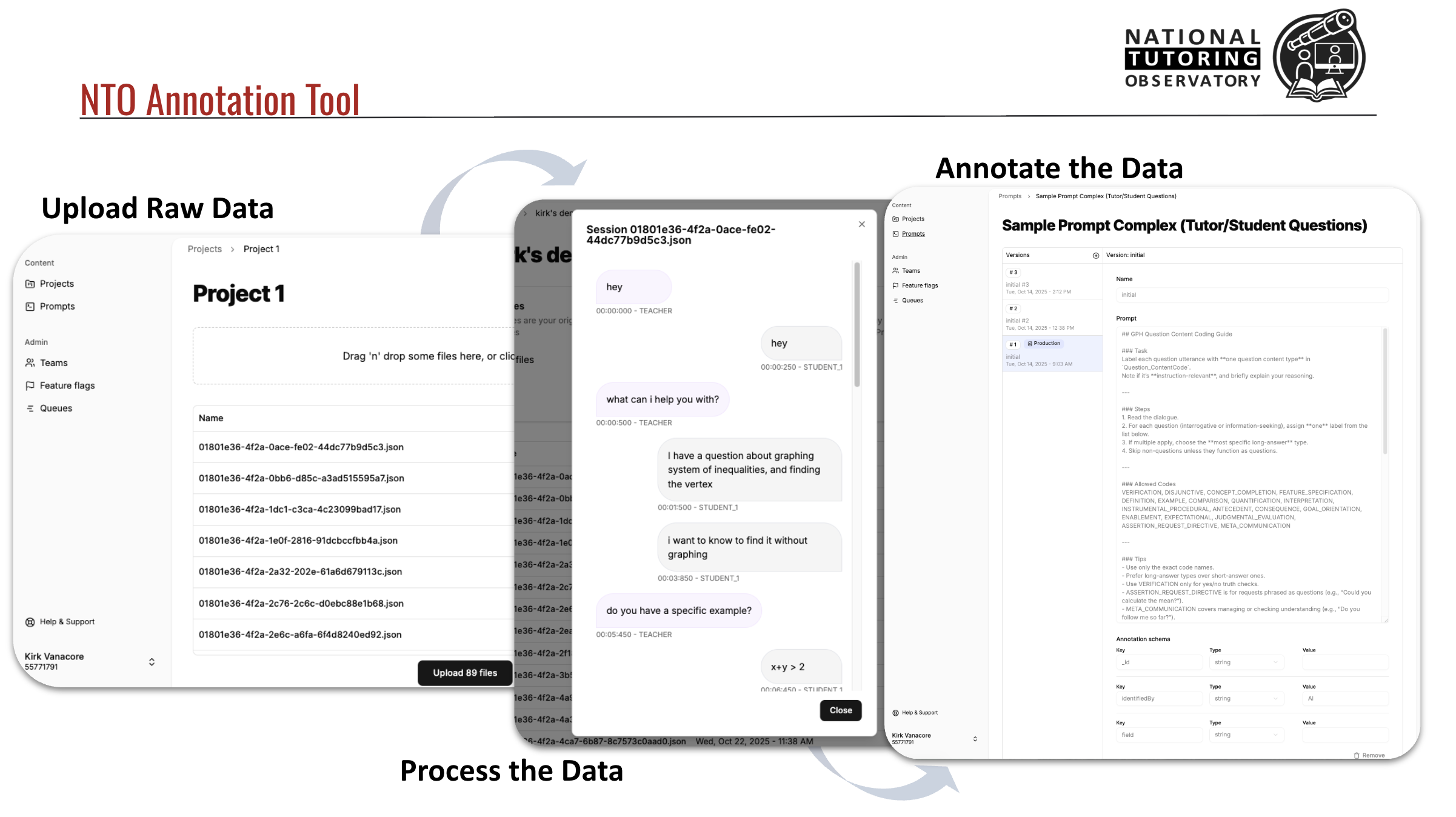
AI-Powered Annotation Tools for Researchers
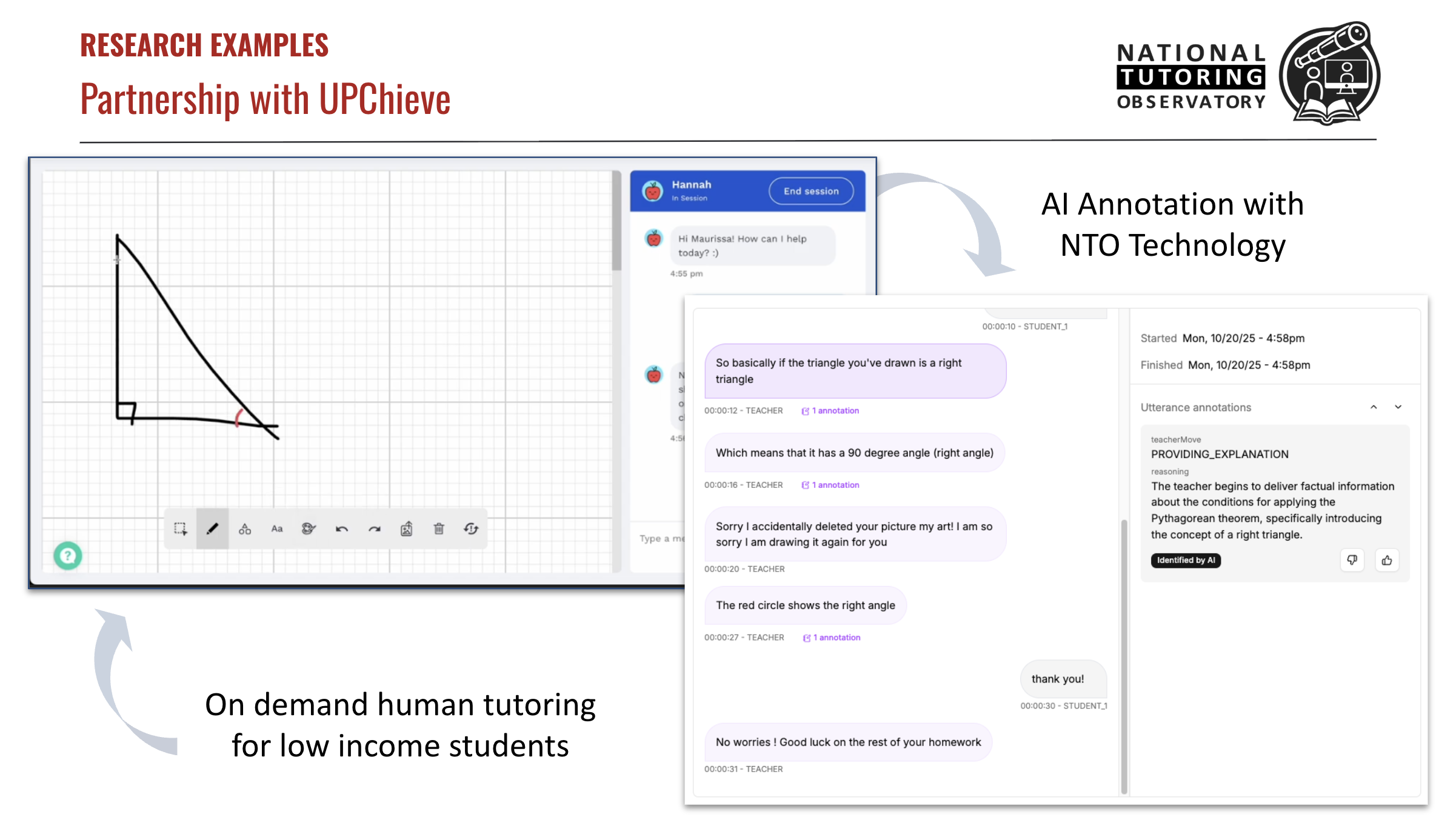
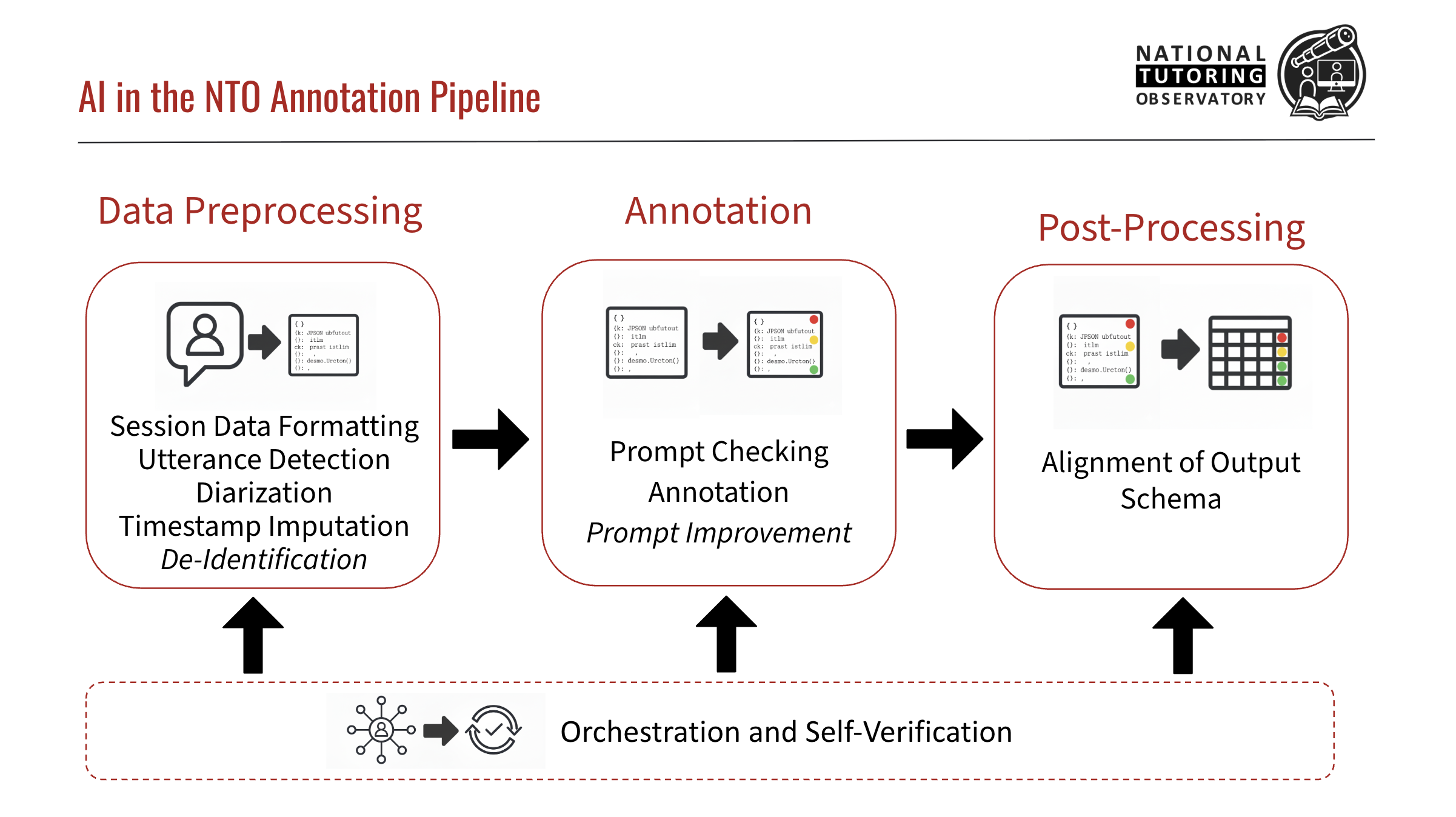
To accelerate the analysis of complex learning environments, the National Tutoring Observatory is developing and providing an open, modular AI pipeline to automate critical data transformations. This includes tools for transcribing audio, de-identifying sensitive information, and segmenting conversations. A key feature for researchers is our AI-powered annotation tools, which are designed to automatically tag important instructional features within tutoring sessions. These classifiers can identify and label key tutor moves, student outcomes, and other significant interaction events.
These tools are built on recent advances in multimodal and generative AI, making it feasible to analyze tutoring data at scale while maintaining high fidelity. Researchers will no longer need to build custom pipelines from scratch. Instead, the NTO provides scalable, reproducible workflows as shared infrastructure. We also perform validation studies to test our AI-powered annotations against human-labeled data to ensure reliability. By leveraging these tools, researchers can more efficiently study how specific tutor behaviors correlate with student engagement and learning, helping to build an empirical evidence base for what works in tutoring.
To access our tools, please see our GitHub repository.